


Nattokinase 10,800 FU - Enteric Coated
Nattokinase 10,800 FU - Enteric Coated
Most nattokinase never makes it past your stomach. Here’s why that matters.
Nattokinase is a fibrinolytic enzyme from fermented soybeans, traditionally used in Japan to support cardiovascular and circulatory health. But enzymes are fragile. Stomach acid breaks them down before they can enter the bloodstream, where research shows they actually do their work. Take nattokinase with food or in a standard capsule, and most of the enzyme may be destroyed before it ever reaches the small intestine.
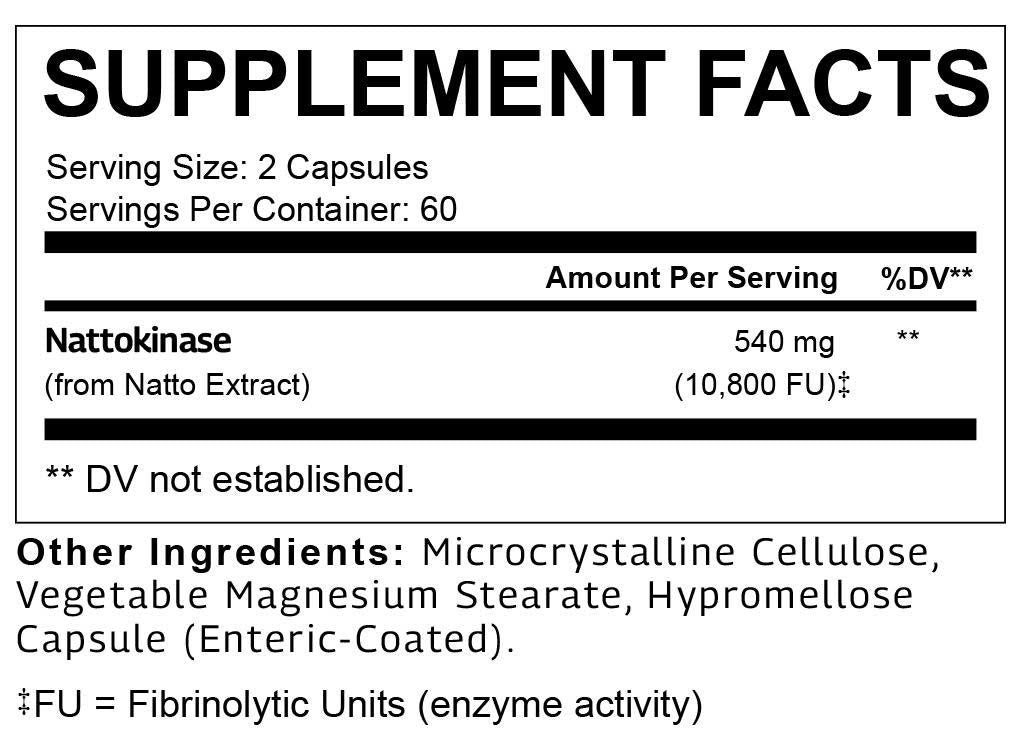
The dose only matters if the delivery works. The landmark 2022 cardiovascular study used 10,800 FU per day for 12 months. But nearly every 10,800 FU product on the market sits in a standard capsule with no protection against stomach acid.
Therexa Nattokinase 10,800 FU is enteric-coated, engineered to resist stomach acid and release the enzyme in the small intestine where it can be absorbed. One clean ingredient, one capsule coating built to protect what you’re paying for. †


This product is Clean Label Project Certified and has earned the Purity Award, placing it among the top 33% of products tested in its category for purity.
Benefits
Benefits
Shipping & Return
Shipping & Return


Product Transparency
From Fermentation to Verified Finished Product
See how Therexa Nattokinase 10,800 FU moves from a non‑GMO soybean substrate through fermentation, extraction, activity standardization, enteric encapsulation, and independent U.S. laboratory verification.
Manufacturing Journey
From raw material to finished capsule
Base substrate for traditional natto fermentation
B. subtilis var. natto naturally produces nattokinase
Enzyme extracted from fermented material, then concentrated
Raw-material activity, standardized for consistency
~21,000–24,700 FU/gStandardized material formulated to final serving strength
10,800 FU / servingIntact under gastric conditions, releases in the intestine
Production & Testing Responsibilities
How the ingredient, finished capsule, and independent testing are separated
Raw‑Material Production
Fermentation → Extraction → Concentration → FU Standardization
Finished‑Dose Manufacturing
Finished-dose formulation → Enteric encapsulation
Independent Finished‑Product Testing
Independent U.S. laboratory testing
Tested in the USA
Independent U.S. Laboratory Verification
The finished product is evaluated for potency, contaminants, microbiology, and enteric performance through independent U.S. laboratories.
Potency
Starya Labs
Chino, California · ISO/IEC 17025
Finished-product fibrinolytic activity testing.
Purity + Microbiology
Analytical Resource Labs
Lehi, Utah · ISO/IEC 17025
Arsenic, Cadmium, Lead, Mercury, plus microbiological screening.
Enteric Performance
Eurofins
Madison, Wisconsin · ISO/IEC 17025
Clean Label Project — Third-Party Certification
Independent product certification covering multiple testing categories.
Testing & Documentation Coverage
What is supported across production records, laboratory testing, and third-party certification
Technical Transparency & Verification Boundaries
How Therexa Nattokinase 10,800 FU Is Made
Non‑GMO soybeans are fermented with Bacillus subtilis var. natto, producing nattokinase during fermentation. The enzyme is extracted, concentrated, and standardized to approximately 21,000–24,700 FU/g at the raw-material stage.
The standardized ingredient is formulated to deliver 10,800 FU per serving, placed into an enteric-coated capsule, and the finished product is independently evaluated in the United States for potency, heavy metals, microbiology, and enteric performance.

Every Batch. Tested. Published.
We send every Therexa product to independent, accredited laboratories in the United States for third-party testing. Then we publish the results — not summaries, not badges, the actual reports.
Heavy Metals (Every Batch)
Every batch is screened for arsenic, cadmium, lead, and mercury to ensure safety.
Microbial Contamination (Every Batch)
Every batch is tested for bacteria, yeast, mold, E. coli, Salmonella, and other pathogens.
Identity Verification (Annual)
Each product undergoes annual identity testing to confirm the ingredients match exactly what's on the label.